TLDR: We are trying to govern a technology while our human relationships with it, and the society around it, are still being negotiated.
Lately, I've been thinking about what happens to us when Artificial Intelligence becomes part of how we think and live. In this piece is a compilation of the questions I looked into.
Table of Contents
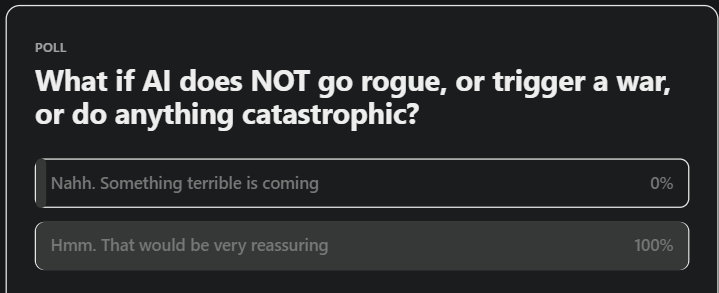
results from the recent poll
1. Electricity or calculator?
Calculators are incredibly useful. They changed how we work with numbers today.
I ask you now: What is 2+2?
Well, we can still do without them. I think you know 2+2. . .
Electricity however, was completely different, because it quickly became bedrock for many other advancements. From discovery into widespread use, industries, technologies began reorganizing around it.
The analogy isn’t perfect, and AI could be something else entirely, but the question here is:
What happens to businesses, societal function, & institutions when Artificial Intelligence becomes like basic infrastructure?
Quick definition of terms
-
Infrastructure is a system that other activities depend on and reorganise around, the way industries reorganised around electricity.
-
Epistemic dependence is relying on another person or system for knowledge, judgment or understanding.
-
Manipulation is influencing a decision in a way that bypasses the person’s own reasoning, rather than informing it.
2. From useful to hooked.
Artificial Intelligence is moving from something we use to something we rely on.
In a previous recent article, I explored epistemic dependence, the idea we can count on another person/system for knowledge, judgment or understanding.
It can be rational, but also has its cons, for example, leading to less critical thinking. Here are some questions:
-
As confidence in AI tools increases, are you getting better at thinking, or replacing the art of thinking?
-
What happens when you become less confident in your own judgment because a model has given an answer?
-
At what point does useful assistance become unhealthy dependence?
3. What is really abnormal?
In our conversations about AI safety, how do we determine whether something is actually harmful when the technology itself is becoming normal?
Do we study the abnormal to understand the normal, OR do we observe the abnormal to define what is normal?
Medicine teaches us that disease teach us what healthy functioning looks like. Other times, studying normal biological processes allows us to recognize when something has gone wrong.
We are integrating artificial intelligence into our lives while still understanding what ideal human function is. When does assistance become substitution?
-
Can personalization become manipulation, and how?
-
As AI becomes more normal, what dosage of AI is healthy for the average person?
-
How exactly do we measure that?
Perhaps some of these questions are why we have not cracked safety, governance?
This piece is part of my efforts to understand how policies shape technology, especially AI. Or how AI shapes policy? Well, both. Subscribe to get every new publication in your inbox.
Some good reads:
-
Psychiatric Nursing, 5th edition, Annie Altshul
-
is AI the voice in your head? Chibuzor Nwachukwu
-
How Training Data Became a National Security Issue (Inside my AI Law & Policy), Nita Farahany
-
Asymmetric Cyber Warfare is Here, Reid Hoffman